
Reading about big old boats sunk in the ocean
Book Talk: Dead Wake: The last voyage of the Lusitania by Erik Larson
In the early months of World War 1, Germany’s U-boat submarines were sinking any ship in the waters surrounding England. But they had yet to sink a passenger ship of any significant scale.
On May 1, 1915, the Lusitania, one of the largest luxury passenger ships on the water, was set to leave New York City for Liverpool. In the newspaper the morning of the departure, the German embassy warned that any ship passing through British waters, which had been declared a war zone, would be attacked.
The Lusitania sailed anyway, with 1,960 people aboard.
We all know what happens to the Lusitania. It’s now at the bottom of the Celtic sea, 11 miles south of Ireland.
But in Dead Wake, it doesn’t matter that the ending has been spoiled before we start reading. The joy in this book is reliving the moments leading up to the attack. We plod through the final days in real-time but with deep behind-the-scenes access to what was really happening.
Erik Larson is so good at bringing life to dry history. This is a book filled with the detailed stories of individuals: American passengers, the ship’s captain, sitting President Woodrow Wilson, British intelligence, and German military officers.
We learn about specific passengers. Why they were getting on the ship, what they brought with them. There was a mom and her children, there was a rare book collector, a Vanderbilt, a very experienced captain, a group of people forced to transfer from a different boat at the last minute.
We also spend time with the captain of the U-boat that eventually torpedos the Lusitania. He was, unfortunately, very good at his job.
All their stories compile together in vivid details to make a historical moment feel alive. You live the growing suspense of the time—in the moment war progresses in unknown ways—and we experience the inevitability of the tragedy growing first-hand.
You gotta read this book
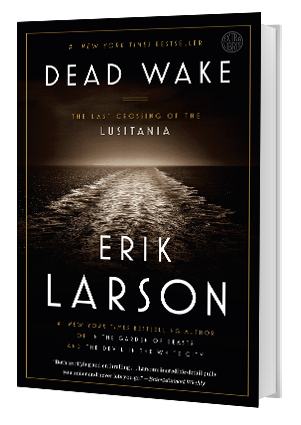
You don’t have to care about big ships or war history to enjoy this book. But by the end, you’ll care about ships and war history.
You’ll have googled starboard and bow and aft, if you’ve never spent time on boats.
You’ll spend time in Google maps trying to find the tiny islands mentioned where U-boats sailed and ships got torpedoed. The details goad you into wanting to know more and to understand it better. And for that, you not only get to enjoy a great story, you’ll have a deeper grasp of the significance of the Lusitania — why have you heard about it? Why did your middle school history teacher even mention it?
You’ll see how good storytelling can carry a book even when the ending has been spoiled. There is no lack of tension here even though we know before we open the book that the ship is doomed.
To get you primed, here’s a silent film of the Lusitania leaving New York City on its final voyage. A few days later, this ship will be sunk.